











JOIN NOW
our Italian Cooking
Newsletter
our Italian Cooking
Newsletter

Publication or use of pictures, recipes, articles, or any other material form my Web site, on or off-line without written permission from the author is prohibited. If you would like to use my articles on your Web site or in your publication, contact me for details. Avoid infringing copyright law and its consequences: read the article 7 Online Copyright Myths by Judith Kallos
Read our
DISCLAIMER and
PRIVACY POLICY
before using
our site
-------------------
Linking Policy
Advertise with us
DISCLAIMER and
PRIVACY POLICY
before using
our site
-
Advertise with us
Copyright © 2003 - 2011 Anna Maria Volpi - All Rights reserved.
Anna Maria's Open Kitchen Site Map

site map
recipes
policies
about us


Some More Hot Topics You'd Like to See adv.




Anna Maria Suggests
Extra-
The Best Selection of Italian Extra-
Buy from the source Authentic Aged Traditional Balsamic Vinegar from Italy
Sicily, Apulia, Lazio, Liguria, and More...The Best Selection of Succulent Italian Olives Oil
Infused Extra-
Spice up your dishes with Infused Flavored Italian Extra-
A Passion for
Gelato
Gelato
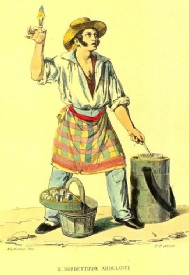
Il Sorbettiere Ambulante,
(The Sorbet Seller),
Francesco de Boucard,
Usi e Costumi di Napoli e Contorni, 1857-1866
(The Sorbet Seller),
Francesco de Boucard,
Usi e Costumi di Napoli e Contorni, 1857-
Eating gelato is an Italian favorite. Italians may not have invented it but without a doubt they perfected it and made it popular around
Should we be surprised that a fisherman from Sicily introduced France and Europe to the pleasures of ice cream?
It is not surprising when we consider that sorbet has a long tradition in Sicily, where ice drinks called “sherbet,” flavored with local fruit, were prepared among the Arab population as early as the seventh century.
It is not surprising when we consider that sorbet has a long tradition in Sicily, where ice drinks called “sherbet,” flavored with local fruit, were prepared among the Arab population as early as the seventh century.
Ice Cream Cart
Patrick Brydone, a Scottish nobleman, visited Sicily and Malta in 1770 and wrote an interesting book about his travels. In his writings, he noted that “even the peasants regale themselves with ices during the summer heats […] and there is no entertainment given by the nobility of which these do not always make a principal part.” When he visited the underground caves filled with ice, he remarked that the peasants made the finest ice-houses. It was the peasants of Sicily who supplied ice to the confectioners, street sellers, and cafés of the island.
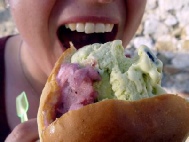
Gelato Panino
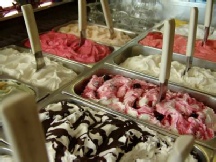
A Gelateria (Ice Cream Shop)
Brydone also remarked that “a famine of snow, they themselves say, would be more grieving than a famine of either corn or wine.” The use of snow for icing water was even intensified by the demand of physicians who recommended the use of ice for fever and other diseases.
Snow was for the Sicilians a commodity of vital importance, and they themselves observed that without the snow from Etna, Sicily “could not be inhabited, so essential has this article of luxury become to them.”
Snow was for the Sicilians a commodity of vital importance, and they themselves observed that without the snow from Etna, Sicily “could not be inhabited, so essential has this article of luxury become to them.”
Food Historians can’t agree about the origin of ice cream but if we go back in time we see that the use of ice to prepare frozen desserts in Italy and the Mediterranean goes back thousands of years.
Ice cream started as a sorbet. It is easy to make just by taking white snow from the mountains and flavoring it with fruit juice, honey, or sweet wine. The main problem, in the pre-refrigerator ages, was how to store this natural ice from the winter, so that it could be enjoyed during the summer. The solution was found in underground cellars where the ice could keep, at least for a while.
Ice cream started as a sorbet. It is easy to make just by taking white snow from the mountains and flavoring it with fruit juice, honey, or sweet wine. The main problem, in the pre-
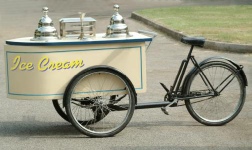
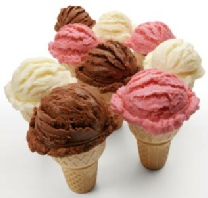
Ice Cream