



wpb0336f6b_1b.jpg
wp3b889929_1b.jpg
wp5533b116.gif
wp6865dccb.gif
wp5533b116.gif
wp3a8650ca_1b.jpg
Join Anna Maria’s
Newsletter
Subscribe today
and win a cookbook
wp5533b116.gif
wp89362d55_1b.jpg
Shopping
Mall
wp4c3d598c_1b.jpg
wp457a6db7_1b.jpg
wp5533b116.gif
wpb2373436_1b.jpg
wpaf6a6d4a_1b.jpg
wped671fee_1b.jpg
wpcdab5bf1_1b.jpg
Italian Menus
by Regional Style
wp5533b116.gif
wpdbe2796a_1b.jpg
wp64d58193_1b.jpg
wpbacc69a3_1b.jpg
wp3195c06f_1b.jpg
“Excuse me. Can you show me where the Piazza Ancillotto is?”
“I am sorry, I don’t know,” replied the elegant lady whom I had addressed.
“I am looking for the restaurant Le Beccherie.”
“Oh, yes! Le Beccherie. Go straight along the portico and then turn right.”
Remarkable! It’s the third time I asked, and although nobody seemed to know the name of the square, everyone was able to point me to Le Beccherie.
It was a beautiful evening toward the end of September, and Treviso was a splendid city. I had to leave my car in the parking lot outside the pedestrian zone, and it was a pleasant walk under the portici of the ancient medieval downtown. I passed along the side of a princely palace and crossed the magnificent Loggia dei Cavalieri. The stores were still open, and the streets were full of people. However, it was not so easy to find my way, and I had already gotten lost three times.
TIRAMISU’, A TRIP TO  WHERE IT ALL STARTED

Visiting “Le Beccherie”, an Interview with Mr. And Mrs. Campeol

by Pietro Mascioni, Sept. 2006
wpd73fb7c1_1b.jpg
Read our DISCLAIMER and PRIVACY POLICY before using my site.
Home    Open Kitchen    Shopping    Resources    Contact us    Site Map
Copyright © 2003, 2004, 2005 Anna Maria Volpi - All Rights reserved.
wpd5e3b54f_1b.jpg
Article
Index
Open
Kitchen
Recipe
Collection
Picture
Galleries
Guest
Cooks
wpd1cdb61d_1b.jpg
wp5533b116.gif
wp5533b116.gif
wp5533b116.gif
wp5533b116.gif
wp5533b116.gif
wp8aae9d56_1b.jpg
wpf37aae63_1b.jpg
THE TRUE HISTORY
OF TIRAMISU’
wp96bd5eac_1b.jpg
All About
TIRAMISU’
wp5533b116.gif
wp5533b116.gif
wp2cf45adf_1b.jpg
Annamaria’s
Classic Tiramisu’
wp5533b116.gif
wp425ba162_1b.jpg
Tiramisu’ with Mixed Berries
wp5533b116.gif
wp79378873_1b.jpg
Don't keep UpNorthCoffee.com secret.
wpdf4e6f2f_1b.jpg
Duomo Tiramisu’
wp5533b116.gif
wp2cf7b94d_1b.jpg
Crespelle
Tiramisu’
wp5533b116.gif
wp5361f70b_1b.jpg
Tiramisu’ Ice Cream
wp5533b116.gif

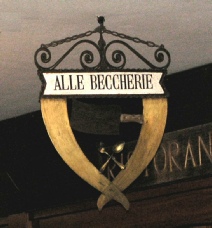
The sign outside the

Restaurant  “Le Beccherie”

in Treviso

wp7379e134_1b.jpg
I had been thinking of visiting Le Beccherie for a while. It was possibly there that Tiramisù was invented. I had researched and found the first written documentation of this dessert. A 1981 article by Giuseppe Maffioli had piqued my curiosity, and I was determined to find out as much as I could about the origins of Tiramisù.
Giuseppe Maffioli (1925-1985) was a famous gourmand, a member of the Italian Cuisine Academy, an actor, writer, journalist, and the founder of a magazine called Vin Veneto, which means, “wines of the Veneto region.” In 1981, in an article about coffee-based desserts, he wrote:
Recently, just a little more than a decade ago, in the city of Treviso, there emerged a new dessert: the Tiramesù. It was proposed for the first time at the restaurant Le Beccherie by a certain pastry chef named Loly Linguanotto, who had by chance freshly held a few jobs in Germany. The dessert and its name, “Tiramesù,” meant to describe an extraordinarily nutritious and invigorating food, immediately gained popularity. Tiramesù was prepared with absolute faithfulness or a few variations not only in the restaurants of Treviso, but the entire Veneto region and in all of Italy. The Tiramesù is, after all, a coffee-flavored “zuppa inglese” like the one made in my own house on the day of St. Joseph for my grandfather’s birthday. This old preparation, though, was not yet Tiramesù, and it must be said that the name has its own prestigious importance.
wp12c17d62_1b.jpg

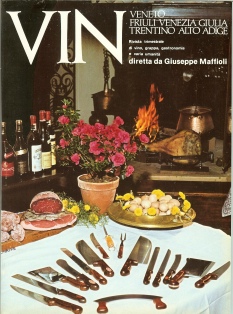
Cover of the number 1

of the magazine

“Vin Veneto”

published by

Giuseppe Maffioli

in the Spring of 1981.

Finally, I got to the Piazza Ancillotto. The famous restaurant Le Beccherie was almost hidden in the corner. There were tables set up outside under a large portico while the ambiance inside was elegant and classic. It was early, and there were not yet many patrons except a few tourists that had ventured inside. Most of the customers would arrive later, around nine in the evening, as is usual in Italy. Carlo Campeol, the current owner, greeted me with an energetic handshake and a wide smile. Gentle and elegant, he looked more like an aristocratic Venetian lord than a restaurant owner.
“Well, I am going to challenge you, Mr. Campeol. What do you have to say about the story that Tiramisù was invented in Baltimore?” I asked.
 “Do you know the proverb, ‘Defeat has only one mother, while victory is the offspring of a hundred fathers’?” he asked.
“No. What does it mean?”
“Well, if you fail in something, it is your own responsibility, but if you are successful… Well, if you are successful, hundreds of people suddenly spring up, ready to try to take the merit.”
“Then, please tell me who invented the Tiramisù.”
“My mother invented Tiramisù here at Le Beccherie in 1971. It is a simple variation of the zabaglione cream that has been prepared for generations. We still make it with the same recipe, exactly as we did thirty-five years ago.”
“And what about the claim that somebody else in town sold Tiramisu’ to Le Beccherie, and you passed it off as your own?”
“We are a reputable restaurant and have never in our long history bought from outside suppliers. All our desserts have always been carefully produced in our own kitchen.”
“And your parents are still here in the restaurant?”
“They don’t work in the restaurant anymore, but they are here, and I will introduce them to you.”
wpc5dcaa5c_1b.jpg

Mr. Aldo and Mrs. Alba Campeol, former owners of “Le Beccherie” who invented the Tiramisu’ in their restaurant  the early 1970s.

Finally Mr. Aldo and Mrs. Alba Campeol, an adorable couple, entered, and I introduced myself.
“I am honored. Such a pleasure.”
“I was young when I began,” said Mrs. Campeol, “I have worked all over to learn. Being a restaurateur is a hard line of work.”
She then began to tell of experiences in Milan and the good reviews she and her husband had received for their traditional approach to the regional cuisine of Treviso.
“Please tell me the story of Tiramisù,” I asked. “How did you invent it?”
Her face lit up as she narrated her story. “When my son was born, I was very weak, and my mother-in-law, to help me recuperate some energy, gave me a zabaglione. You know, a simple one like the kind we make in Treviso, egg-yolk and sugar beaten together, with a bit of mascarpone cheese.”
At this moment, a flashback appeared vividly in my mind. I remembered that when I was a boy, my mother would give me zabaglione made with egg-yolk and sugar beaten together until white and fluffy. “You need to grow, you need to study,” she would tell me, “come on, eat it. It will give you energy.” I also remembered how much I hated having to beat the egg in the morning before going to school, but also how tasty and soft it was.
wp20c6627f_1b.jpg
“That time,” Mrs. Campeol continued, “my mother-in-law also added a bit of coffee to it. ‘Mangia,’ she told me, ‘It will lift you up.’ It was so good that when I went back to the restaurant, I told Lello--
“Excuse me,” I interrupted. “Who is Lello?”
“Roberto Linguanotto. We called him Lello. He was the chef who worked with us. I said to Lello, ‘Why don’t we try to make a dessert out of this?’ And he had an idea to make layers of Savoiardi [ladyfinger] cookies dipped in coffee. Then we added the cocoa topping. It was then that I remembered my mother-in-law’s words, and we called it ‘Tiramesù.’ [‘Tiramesù’ means ‘lift me up,’ or ‘pick me up’ in the Venetian dialect.] When the rumor about the dessert spread, people were coming from all over Treviso and beyond. Even the chefs and pastry chefs came to taste it. After a while, there were a lot of people from this area that claimed to have invented it. Who would have thought then that it would become so famous,” Mrs. Campeol regretted. “If only we had known!”
When the Campeols got ready to leave, Mrs. Campeol shook her index finger in the air almost as if to reproach me, and said, “Please don’t put any liquor in the Tiramisù because we give it to children and elderly people for energy.”
The way in which Mrs. Campeol explained this event so far away in time was simple and logical. Is it not like this, in fact, that many wonderful preparations are born, from the evolution of an already existing dish? I think of the Pizza Margherita, of Carpaccio, and of Pasta all’Alfredo, all born from the creativity of a chef in a moment of inspiration.

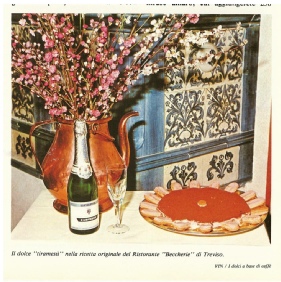
The first known picture of a

Tiramisu’, taken in the restaurant

Le Beccherie in 1981.


This picture was printed on page 69

in the magazine “Vin Veneto”

published by Giuseppe Maffioli

in the Spring of 1981,

for an article dedicated

to coffee-based desserts.


The caption under this picture reads:

The “Tiramesu”  dessert in the original recipe of the restaurant “Beccherie” in Treviso.

I looked around while I waited for the bill. Hanging from a wall, an old diploma read, “From the members of the Academy of Italian Cuisine to the Campeol family, who in the ancient restaurant Le Beccherie, continues the best tradition of the Treviso cuisine. Treviso, December 19th, 1974.” It was followed by the signatures of the twenty members from all over Italy. As I scanned them, I balked with surprise: in the left corner, I noticed the signature of Giuseppe Maffioli. I felt like an archeologist who had discovered a new treasure.
How could I not read a sign in this last-minute little discovery of mine? There in front of me was a message from the past. Maffioli, a regular at Le Beccherie, had organized a meeting of the most prestigious culinary organization in Italy right there during the years Tiramsù had first started to appear.
Arrigo Cipriani, the owner of the Harris Bar and inventor of the Carpaccio, in the preface of the book “Il Ghiottone Veneto [The Venetian Glutton] described Giuseppe Maffioli as:
A big, fat man, who was always in a rush, restless, and in a way not congenial with his size. […] When he came to our restaurant [The Harris Bar], he said, “Buondi’ Paron” [“good morning chief,” in the Venetian dialect]. He addressed me without smiling, and walked right into the kitchen, where he put his index finger in the boiling broths and sauces on the stoves without a care about the astonished chefs. He tasted everything and said, “Bon!” [Good!]

If Maffioli, an inquisitive gourmet and food critic in a small town like Treviso, was truly such a man, then he would have known if someone outside of Le Beccherie had created the resounding recipe.

After hearing the story of Mrs. Alba Campeol and reading the documents written over twenty-six years ago by a member of the Academy of Italian Cuisine, what else is necessary to dispel all the bizarre and unfounded stories about the origins of Tiramisù? I have no doubts that Tiramisù was first prepared at Le Beccherie. My research had come to an end. In a simple and logical way, the circle closed.
wp1a4fc4f0_1b.jpg
It was finally time for dinner. I never liked eating alone, but my meal at Le Beccherie was exceptional, robust, and refined at the same time. I had soppressa, a type of local salami, baccalà mantecato, salt cod slowly cooked in milk, and polenta with mushrooms as appetizers, and then pasta e fagioli Trevigiana, bean soup with radicchio, a traditional peasant dish of Treviso. “It is not our radicchio,” Carlo pointed out. “True radicchio from Treviso is not yet in season. This comes from Soave [a city located closer to Verona at a lower altitude].”  I also had some pheasant, perfectly cooked, with polenta and a liver sauce, and some pearà sauce made with broth and bread. At the next table, they served a filet “alla pietra.” A slab of incandescent stone was brought to the table and the filet sizzled, shortly broiled for a few minutes each side, in front of mesmerized customers.
wp46367c2a_1b.jpg

Pasta e Fagioli alla Trevigiana with the Red Radicchio of Treviso.

Finally came the moment for which I had been waiting. The dessert cart was brought, and immediately noticeable was the famous Tiramisù. Don’t expect exotic flavors. The tiramisu of Le Beccherie is the simplest and most honest Tiramisù that you can eat.
There were no secret ingredients or bizarre culinary inventions. This is a veritable return to the origins. And if you are disappointed, I can only feel pity for you. It means that your palate is not able to appreciate the simplicity of Italian cuisine.

The tiramisu of “Le Beccherie”.

Pietro Mascioni


© Pietro Mascioni 2007, www.annamariavolpi.com

Note:

Original copy

of the magazine

“Vin Veneto”

courtesy of

Mr. Annibale Toffolo,

present publisher

of the magazine

Taste Vin

wpd37ddb3f_1b.jpg
wp605b0fb9_1b.jpg
wp97125dfd_1b.jpg
wp5533b116.gif