












JOIN NOW
our Italian Cooking
Newsletter
our Italian Cooking
Newsletter

Publication or use of pictures, recipes, articles, or any other material form my Web site, on or off-line without written permission from the author is prohibited. If you would like to use my articles on your Web site or in your publication, contact me for details. Avoid infringing copyright law and its consequences: read the article 7 Online Copyright Myths by Judith Kallos
Read our
DISCLAIMER and
PRIVACY POLICY
before using
our site
-------------------
Linking Policy
Advertise with us
DISCLAIMER and
PRIVACY POLICY
before using
our site
-
Advertise with us
Copyright © 2003 - 2011 Anna Maria Volpi - All Rights reserved.
Anna Maria's Open Kitchen Site Map

site map
recipes
policies
about us


Some More Hot Topics You'd Like to See adv.




Anna Maria Suggests
Extra-
The Best Selection of Italian Extra-
Buy from the source Authentic Aged Traditional Balsamic Vinegar from Italy
Sicily, Apulia, Lazio, Liguria, and More...The Best Selection of Succulent Italian Olives Oil
Infused Extra-
Spice up your dishes with Infused Flavored Italian Extra-
Artichoke:
The King of Vegetables
The King of Vegetables
Globe artichokes usually come in 3 sizes, the size depending mainly on the location on the plant. The largest are often located at the top, while smaller artichokes are picked up from the lower branches. American consumers seem to look at size as a sign of quality. Unfortunately, in the case of artichokes, this is not correct. In fact, artichokes that are too big have cores that develop those tough inedible “chokes.” If chokes are present, they need to be scooped away, and all the leaves may fall apart while cooking. In Europe, only small artichokes are harvested. Those that eventually have “chokes” don’t make it to the market because they are considered to be of inferior quality.
The largest artichokes are used for boiling or stuffing, while the smaller ones are the best because they are normally very tender with few or no chokes. Look for the small, “baby” artichokes. They shouldn’t have chokes and should be fully edible. Artichoke plants take up a lot of land. The plant in full growth covers an area of about 6 feet in diameter. This, and the fact that artichokes are hand-picked make them very expensive.
Italy, where Artichokes are grown in practically all of the 20 regions, is responsible for almost 2/3 of the world’s artichoke production, followed by France, Spain, and the USA. Artichokes were introduced in California by Italian farmers in the early 1900s. Today California produces most of the artichokes grown in the United States. Although California artichokes are available all year round, the season peaks in March, April, and May.
Some tips about artichokes:
* Fresh artichokes are solid when squeezed and have compact leaves.
* Don’t use aluminum or iron pans or tool because they confer an unappealing color to the artichokes. Use stainless steel instead.
* Artichokes contain a substance called Cynarin with taste modifying properties, making most food will taste different, sweeter and more desirable. Wine, on the other hand, will taste strange after eating artichokes.
* Artichoke stems are also edible. If the ones you buy have long stems, just peel them, cut them into pieces, and cook them together with the rest of the artichokes.
The largest artichokes are used for boiling or stuffing, while the smaller ones are the best because they are normally very tender with few or no chokes. Look for the small, “baby” artichokes. They shouldn’t have chokes and should be fully edible. Artichoke plants take up a lot of land. The plant in full growth covers an area of about 6 feet in diameter. This, and the fact that artichokes are hand-
Italy, where Artichokes are grown in practically all of the 20 regions, is responsible for almost 2/3 of the world’s artichoke production, followed by France, Spain, and the USA. Artichokes were introduced in California by Italian farmers in the early 1900s. Today California produces most of the artichokes grown in the United States. Although California artichokes are available all year round, the season peaks in March, April, and May.
Some tips about artichokes:
* Fresh artichokes are solid when squeezed and have compact leaves.
* Don’t use aluminum or iron pans or tool because they confer an unappealing color to the artichokes. Use stainless steel instead.
* Artichokes contain a substance called Cynarin with taste modifying properties, making most food will taste different, sweeter and more desirable. Wine, on the other hand, will taste strange after eating artichokes.
* Artichoke stems are also edible. If the ones you buy have long stems, just peel them, cut them into pieces, and cook them together with the rest of the artichokes.
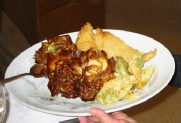
Carciofi alla Giudia (Artichokes Jewish style), with Roman “Fritto Misto” (fried zucchini flower and fried salt cod), as presented in the restaurant “Da Giggetto” in the Jewish quarter of downtown Rome. The artichokes are fried until tender, then pressed to open them up and fried again until the outer leaves are brown and crispy.
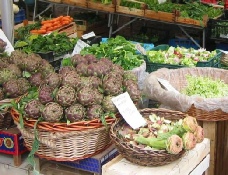
Whole and Cleaned Artichokes, on a stand of Campo de’ Fiori farmers market, in downtown Rome.
Rome is famous for the quality of the artichokes produced in its countryside. Roman artichokes are large and tender, and one variety in particular, called “cimaroli” (literally “those that grow on the top”) is the best one. They are large, globe-like, full of pulp, and with tender leaves. In Rome, artichokes are deep-fried, boiled, used for Frittata (Italian open omelet), for pasta sauce, for risotto, and in a large variety of preparations.
Two famous Roman recipes, Carciofi alla Romana (artichokes Roman style) and Carciofi alla Giudia (Artichokes Jewish style), require the artichokes to be cooked whole.
Artichokes Roman Style are slowly cooked in a pan with olive oil until they become tender and soft.
See recipe on my page.
Artichokes “Jewish Style” are deep fried twice until the outer leaves become brown and crispy. To taste the best artichokes, you have to go to the old Jewish quarter in downtown Rome.
A few very old restaurants will serve you the best traditional Roman cooking such as Fritto Misto (a mix of deep fried vegetables), Puntarelle (the crunchy tips of Calalogna dandelion dressed with olive oil, vinegar, garlic, and anchovies), Saltimbocca (veal scaloppini topped with prosciutto and sage), and much more.
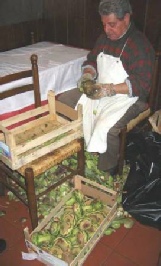
Cleaning Artichokes is a lifetime profession for this gentleman in the entrance of the restaurant “Da Giggetto,” which has operated for several decades in the Jewish quarter of Rome.
Artichokes Flowers If allowed to grow, artichoke buds develop into magnificent purple flowers. They will keep for months if dried.
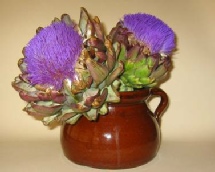
Artichokes (Cynara Scolymus) are originally from the Mediterranean area, and the wild ones were already known to the ancient Romans (i.e. Carduos, their word for thistle). They are the flower bud of a thistle-like plant. The edible part is the bud bottom. The artichoke is nipped in the bud before it can flower so it can be utilized as food, but the flower, if the plant is allowed to flower, is a large blossom about 6 - 7 inch (15 – 18 cm) wide of a deep blue-violet color.
Artichoke Articles and Recipes







