












It has been used as currency, prescribed as medication and also has religious connotations. I am, of course, referring to salt. Living in a society with a seemingly endless supply of options and varieties, it is sometimes difficult to imagine the importance of something so humble and ubiquitous as salt. In an age when new "boutique ingredients" and fad-diets emerge on a daily basis, it's also difficult to realize that salt is essential to survival--your body actually needs it to regulate vital fluids. The paradox is that our body needs salt but cannot produce it on its own, so we consume the salt we need but sometimes far too much, often to the point where it becomes detrimental to our health. The Heart, Lung and Blood institute urges everyone to limit their salt intake to 2400 milligrams a day (about a teaspoon). Currently, the average American diet contains almost twice that amount. It's not difficult to consume, and exceed, your body's daily recommended salt intake, sometimes twice or thrice the amount which is actually required. Salt is naturally found in most foods, with incredibly high percentages in processed foods. On many packaged foods you'll find salt listed within the first few ingredients. The hard, cold fact is that salt, fat and sugar are what make junk food so desirable to our palates. Salt sells. There have been numerous books written on the subject of reducing or omitting dietary salt . This is particularly ironic, due to the fact that in prior centuries wars were actually fought over obtaining the substance. At one time salt was so valued that Roman solders received a salt allowance as a portion of their pay. The Latin term for this allowance was salarium argentum, the origin of the English word "salary" and the French word "argent," meaning silver or money. On a more local scale, the Erie Canal was once known as "the ditch that salt built," because one of its original cargos was salt. The medicinal uses of salt are also great. Ancient peoples learned early on that applying salt to an open or infectious wound would draw out the infection and help it heal. I was working one busy night when a co-worker, who was native to the Caribbean Islands, cut himself badly. I watched in horror as he poured salt directly into the open wound to disinfect it--he didn't even wince, but I did. And who doesn't remember their mother or grandmother prescribing a saltwater gargle to cure a sore throat. The importance of salt as a culinary ingredient is obvious; it's in almost every recipe. Salt is not actually a flavor, per se, but more of a flavor enhancer. A pinch of salt will bring forth the flavors that are already present. Salt can also be used as a cooking vessel similar to clay or terracotta. Salt baking is a very ancient method that has recently become popular. Foods are encased in a sort of salt-dough and baked in a moderate oven, which was initially done in a pit or near an open fire. After baking, the crust is removed and discarded; the resulting product is succulent, flavorful and, surprisingly, not salty. Preservation is another primary use of salt. Foods coated with salt release some of their juices and, to a certain extent, dry out, which considerably increases the shelf life of perishables. Prior to modern refrigeration this technique was of utmost importance, but today it's a matter of taste. One of the most common salted foods is gravlox, which translates loosely to English as "buried salmon." As the name suggests, it was originally a recipe that entailed salting and burying the fish in the coolness of the earth in order to preserve it. To make a contemporary gravlox, the fish is spiced and salted, then weighted and refrigerated for at least 72 hours. Though it is not technically cooked by heat conduction, the resulting texture is somewhat firm and very similar to that of smoked fish. Joseph George Visit Joseph 's website: http://members.localnet.com/%7Ejgeorge/ Joe is a chef, culinary educator and writer- is a graduate of The Culinary Institute Of America, and The School For American Chefs. He has also studied at The New School For Social Research in New York City and Le Cordon Bleu, in both Ottawa and Paris. He is the past co-owner of the acclaimed Café Cosmos, in Buffalo, New York and has been chef at numerous Buffalo area restaurants. Besides maintaining his own web site (Joe's Cyber-Kitchen) his work has appeared in both national and local publications, including Chef Magazine, Artvoice, Sally's Place, One4.com, Fillet and The National Culinary Review. He is the author of a self-published book, Basic Elements: A Recipe Book Of Soup And Bread, and also worked as recipe tester for the Northeast Organic Farming Association Cookbook. Joe is currently teaching private cooking classes, and is a part-time instructor at Erie Community College. He lives in Buffalo with his wife Carrie Marcotte and their son Isaac George Visit Cheftalk.com a food lover’s link to professional chefs
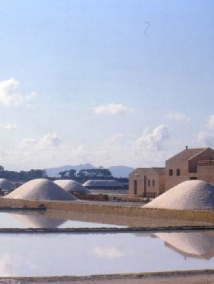
Saline - Piles of salt at the salt ponds near Trapani in Sicily. Picture courtesy of Alessandra e Massimiliano http://www.maxt.it/
This substance looks innocuous enough: white, granular and on every table in America. Yet it is an essential element in the diet of humans and most animals; it's also one of the most effective and widely used food preservatives.